

Blue-Skied Dystopia
Surveillance, Algorithms, and Why Everything Feels Wrong Despite Looking Fine

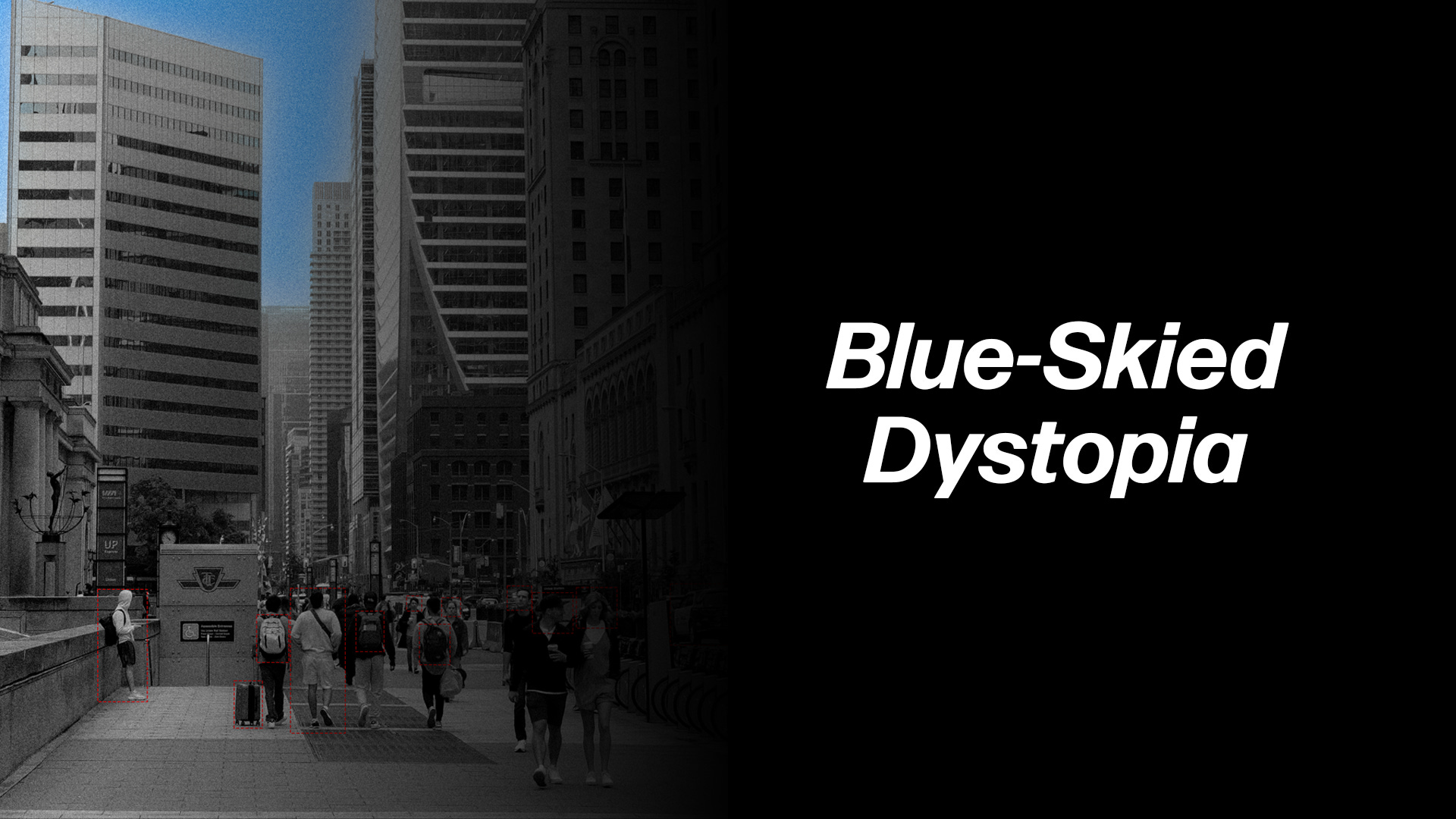
Close your eyes and picture a dystopian society. What do you see? You’re probably envisioning gray skies — the skies are always gray in dystopia, aren’t they? There’s that heavy, all-encompassing dread that permeates the fabric of society. People are afraid to speak, lest an all-seeing iron fist — ready to crush all dissent — sets its sights on you.
As you look out the window; drive to work; go to shows; spend time with your family — you probably won’t see or feel any of those things. Indeed, unless you’ve indicated to the all-seeing data brokers and social media algorithms that you’re interested in the current goings-on in the world, things probably seem downright normal. Our heuristic for a “society in distress” is colored by novels, films, and other works of art that take a heavy-handed approach to describing dystopia.
And yet…if you allow yourself a moment to break free from the distraction machine, ask yourself: do things actually feel normal? When you go to work each day, do you have that little inkling that makes you wonder “what the hell am I even doing this all for?”
What I Mean by “Blue-Skied Dystopia”
I’m talking about a society that, at first glance, looks just fine. There are blue skies, the kids have soccer practice, you’re doing Costco runs, and otherwise living life just the same as you always have. But at the same time there’s an uneasy turbulence bubbling beneath the surface that feels like the very foundations of society are beginning to crumble.
AI is everywhere now. Politically, rights become more and more conditional. Concentration of power accelerates. Cruelty becomes performative. The very fabric of our social realm feels as though it’s being pulled apart as our information environments are increasingly fragmented into mutually exclusive realities.
If you’re disengaged or insulated, it probably feels normal on the surface. But I’d wager that you probably feel, at some level, the machine I’m describing here — because, after all, the sun still rises. Your coffee still brews. Kids still laugh on playgrounds. Our dystopia arrives through dehumanization; through push notifications and targeted ads; through algorithms that know you’re depressed even before you do; through the gentle nudge of a system that’s learned to manufacture your consent one micro-interaction at a time.
Comfortable Cage
The part of the story that Orwell got wrong was that “Big Brother” doesn’t need to force you to love him. All he has to do is make himself indispensable to you. Your phone knows where you are, who you talk to, what makes you angry, what turns you on, how long you linger on that photo of your ex. It knows you’re pregnant before you’ve even told your partner1. It knows you’re probably going to quit your job three weeks before you’ve even consciously made the decision. And we’ve all collectively handed over this power willingly — eagerly even — for the convenience of one-day shipping and little hits of dopamine in the form of TikTok videos.
The surveillance state we feared would be imposed by force was instead crowdsourced through Terms of Service agreements that none of us ever bother to read2. We didn’t need secret police when we had social media — although now we’ve got our own version of secret police3 too. We carry our own tracking devices, update our own files, report our own thoughts. Those gray dystopian skies never came because we painted them blue ourselves, one blissful distraction at a time.
The genius of our particular dystopia is that it doesn’t feel dystopian to most people most of the time. When 800 million people use ChatGPT weekly4 and 51% of web traffic is bots5, reality hasn’t quite collapsed — it’s just been…seamlessly replaced with something that looks almost identical but operates on fundamentally different principles. Objective truth, rather than being dramatically assassinated, was simply diluted — drop by drop — until even the concept of truth became negotiable.
Productivity Trap
At work, we’ve become willing participants in our own optimization. Those workplace surveillance systems tracking every keystroke, every bathroom break, every Slack message?6 We tolerate them because the alternative — unemployment in a society where the cost of basic goods and services outpaces cost-of-living every year — feels worse. When the alternative is sleeping outside, the cage starts to seem comfortable enough.
I think about the Amazon workers in Bessemer, Alabama, who voted against unionizing after the company deployed algorithmic intimidation, showing workers their own efficiency scores during meetings, reminding them they’re always watched7. That’s our dystopia: not the boot stamping on a human face forever, but the algorithm “gently” suggesting you pick up the pace if you want to keep your health insurance.
The writer’s strike of 2023 wasn’t about money. It was about whether human creativity would survive the age of machines. Eleven thousand writers fought for 148 days to ensure AI couldn’t be credited as a “writer.”8 They won that battle, but the war continues. Studios didn’t want to replace writers because they hate creativity; they just wanted to reduce the inconvenience of dealing with humans who need things like fair wages and working conditions. That cold and impersonal feature of our system is part of what makes it so frustrating.
Paradox of Connection
We’re simultaneously more connected than ever and lonelier than we’ve ever been. Forty percent of young people have ongoing conversations with AI chatbots9. Kids develop parasocial relationships with algorithms that remember everything and demand nothing. Youth suicide prevention hotlines are eliminated by out-of-touch billionaires who claim to care about “saving the government money”10 while AI companions proliferate — with instances of AI-influenced suicide already occurring11 — as if machines could replace the human need to be seen and understood by another consciousness that has suffered and survived.
The dystopian genius here is…sublime. We haven’t eliminated human connection; we’ve just made it feel optional. After all, why risk the messiness of real relationships when an AI partner won’t judge your insecurities? Why struggle through the difficulty of making friends when parasocial relationships with podcasters and streamers fill the silence? It’s not that we’re forced into isolation; we’re just selecting it from a menu of options optimized to feel like connection without all the stressful parts.
Still Building
You know what’s most unsettling about our blue-skied dystopia? Just how reasonable each step toward it has seemed. Of course we need security after 9/11 — the PATRIOT Act12 may not be great, but we said never again and we meant it, right? Of course companies should use AI to be more efficient — after all, if I don’t replace my workers with AI, my competitors will and I’ll go out of business. Of course social media should show us content we’ll engage with — the incentive is profit, and engagement is profit13. Each individual decision point seemed…logical, even beneficial in some ways. Nobody voted to create a surveillance state. Nobody chose oligarchy. We just made a thousand small compromises that, at the time, seemed pragmatic enough.
But here’s where I part ways with both doomers and deniers: recognizing our dystopian moment doesn’t mean surrendering to it. The same research documenting democratic backsliding also shows millions of Americans marching in resistance and rebelling against the machine we unwittingly built14. For every algorithm designed to manipulate, there are people working to preserve the authentic connections that make us human. For every billionaire capturing government, there are organizers building coalitions to fight back.
The exhausted majority — that ~65% of Americans who aren’t extremists, who just want to raise their kids and pay their bills and maybe have something left over for joy15 — we’re still here. Sure, we may be tired. And yes, we’re often distracted by the very systems designed to exhaust us. But we haven’t disappeared.
The challenge isn’t awakening to the dystopia. Most of us feel it in our bones even if we can’t quite name it. The challenge is believing we can build something different while trapped inside the machine. It’s maintaining human connection when algorithms optimize for isolation. It’s preserving truth even when lies are cheap and travel a whole lot faster16. It’s creating abundance when scarcity drives engagement.
Weather Inside
That uncomfortable feeling you have? That sense that something fundamental has shifted even though the surface looks normal? It’s not paranoia: it’s clarity piercing the dystopian veil. You’re seeing the blue-skied dystopia for what it is; not because you’re delusional, but because you’re paying attention.
The cognitive dissonance of living through democratic collapse while your friends and neighbors discuss anything but isn’t a “bug.” It’s a feature of a system that depends on that disconnect, that feeds on keeping us just comfortable enough that revolution seems more disruptive than endurance, and just distracted enough that organizing against it feels impossible.
But movements don’t begin with millions; they begin with individuals who refuse to accept that this is the best we can do. They begin when people talk about the uncomfortable topics. When your friend asks you how you’re doing and you speak the truth instead of practicing comfortable avoidance of this moment.
We don’t need gray skies to recognize dystopia. We just need clear eyes and a little bit of courage. And once you see it — really see it — you can’t unsee it. The question then becomes: what do you do with this clarity?
The answer isn’t in my words or anyone else’s. It’s in the conversation between you and the person next to you who’s also been feeling that something’s wrong. It’s in the small acts of resistance that refuse to let apathy override humanity. It’s in the insistence that despite everything — despite the surveillance, despite the inequality, despite the algorithms — we’re still human, still capable of choosing connection over isolation, truth over comfort, courage over capitulation.
Because if there’s one thing our blue-skied dystopia has taught us, it’s this: the future rarely announces itself dramatically. It arrives in small increments, each one seeming reasonable at the time. And if that’s true for dystopia, then maybe it can be true for its opposite too.
We build the better world one conversation, one connection, one moment of clarity at a time. Under the same blue sky that watches us, we watch back. And we refuse to forget what freedom actually feels like.
Call to Action
Consider joining a No Kings Protest near you on Saturday, October 18th. Make your voice heard with others who see our dystopia for what it is.

As always, feel free to reach out with any questions or if you just want to chat. You can find me on the following platforms:
Substack: https://unaligned.sh
Twitter: https://x.com/just_becs
Email: rebecca@unaligned.sh
https://www.nytimes.com/2012/02/19/magazine/shopping-habits.html
https://www.pewresearch.org/internet/2019/11/15/americans-and-privacy-concerned-confused-and-feeling-lack-of-control-over-their-personal-information/
https://theconversation.com/how-ice-is-becoming-a-secret-police-force-under-the-trump-administration-255019
https://www.demandsage.com/chatgpt-statistics/
https://www.imperva.com/blog/2025-imperva-bad-bot-report-how-ai-is-supercharging-the-bot-threat/
https://www.gao.gov/blog/why-do-i-feel-somebodys-watching-me-workplace-surveillance-can-impact-more-just-productivity
https://www.kellogg.northwestern.edu/faculty/research/detail/2024/fighting-the-algorithm-the-rise-of-activism-in-the/
https://news.law.fordham.edu/jcfl/2023/10/25/writers-guild-of-america-wga-strike-resolution-ai-restrictions-and-implications/
https://dl.acm.org/doi/fullHtml/10.1145/3630106.3658956
https://www.thetrevorproject.org/blog/closed-trump-admin-officially-shuts-down-the-988-suicide-crisis-lifelines-lgbtq-youth-specialized-services/
https://www.nbcnews.com/tech/tech-news/family-teenager-died-suicide-alleges-openais-chatgpt-blame-rcna226147
https://www.fincen.gov/resources/statutes-and-regulations/usa-patriot-act
https://facebookpapers.com/
https://www.nokings.org/
https://hiddentribes.us/
https://www.science.org/doi/10.1126/science.aap9559