

The Tyrant's Two Heads: A Civil War for America's Authoritarian Future
Two rival faiths are fighting to rule America. One worships technology; the other God. Both dream of dominion. And between them stands a kleptocrat willing to sell the republic to whichever pays best.

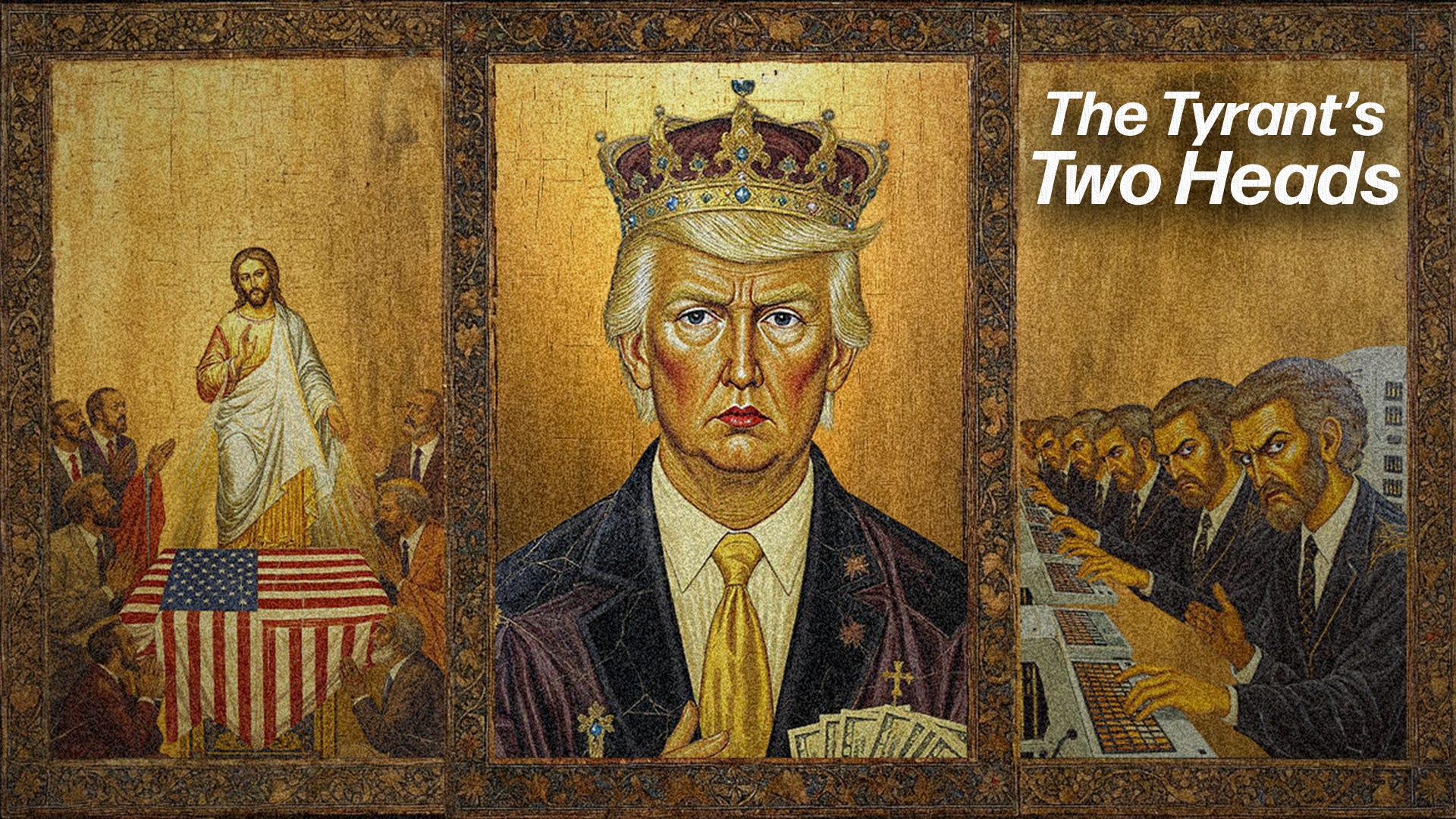
On a gray morning in Washington, D.C., two doors stand open, facing each other across a long hallway. Behind one is a makeshift chapel in a federal conference room. It’s adorned with folding chairs arranged neatly in rows, a lectern draped in a cross painted red, white, and blue, and influential preachers who are practicing just the right words to replace secular law with codified Biblical authority. Behind the other lies a high tech war room. It’s full of monitors, dashboards, and machines siphoning data from, and building surveillance infrastructure for, the American people. AI roadmaps are pinned to the walls. Former tech platform builders are now busy shaping a new kind of state.
Between these rooms, a family strolls by, shopping bags in hand. They don’t glance through either open door; they’re not interested. They’re only here to collect.
That’s the second Trump presidency in a nutshell: two authoritarian factions living under the same roof, neither loyal to the other, and each convinced they are destined for ascendance. On the sidelines sits the Trump family, more than happy to auction off access to the highest (or most flattering) bidder while the house burns down, a kleptocracy that thrives on factional bidding wars and pay-to-play governance. “Supporting” players include legislative and judicial branches that have all but abdicated their own constitutional authorities in the hopes that they can just ride out the turbulence and land back in a world of sanity when all is said and done.
The Gospel of the Machine
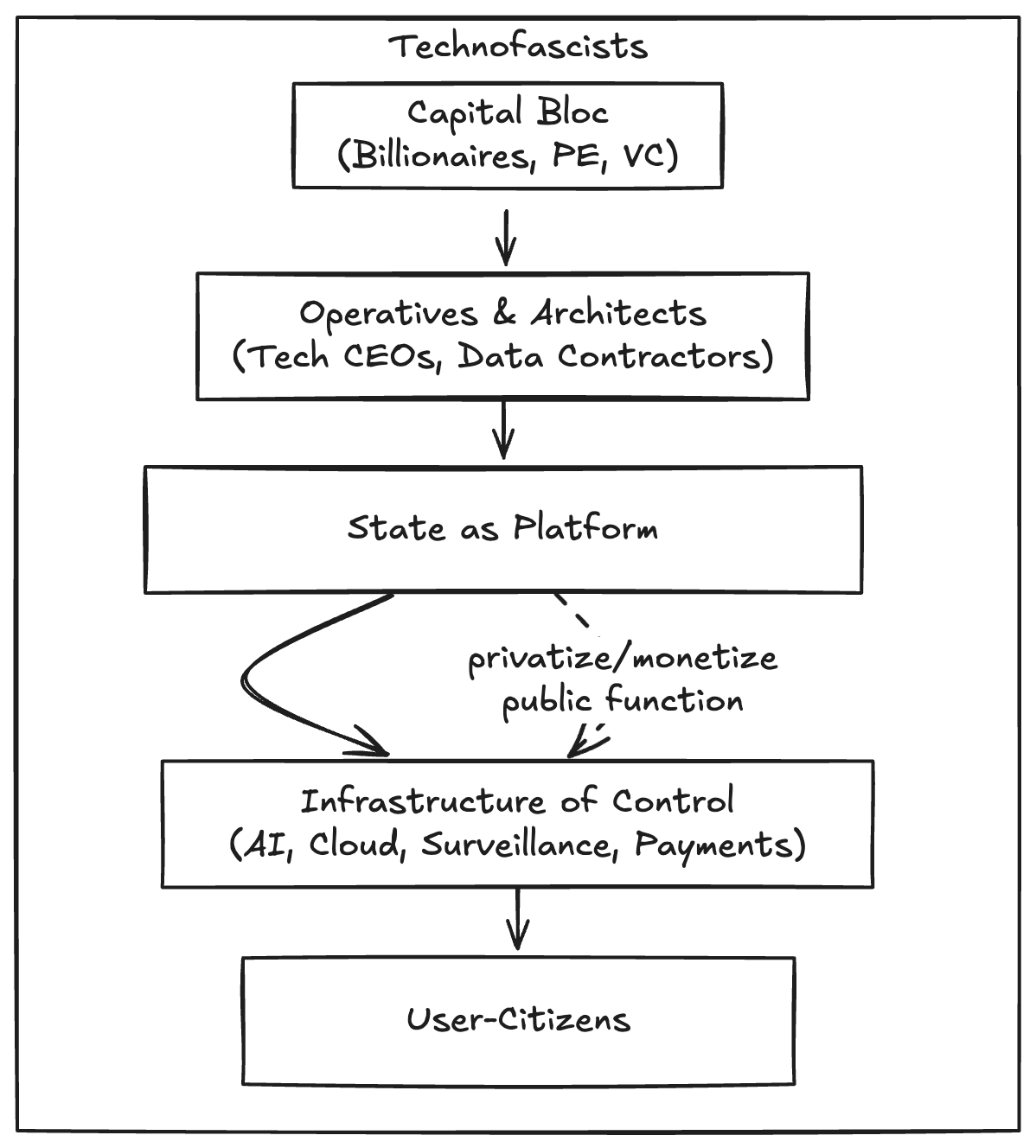
The brain trust behind Silicon Valley’s pivot toward authoritarianism is formed by Peter Thiel’s network. They’ve installed Vice President J.D. Vance as their highest-ranking operative, and he’s surrounded by proteges like David Sacks who are embedded across the federal government. They’ve begun their efforts of reshaping America in the image of venture capital. Their ideology is transparent. Thiel himself declared, “I no longer believe that freedom and democracy are compatible.”
Their endgame isn’t particularly subtle, either. Influenced by their philosophical godfather Curtis Yarvin’s “CEO-dictator” model, their vision of government is one that is just another platform to be optimized and monetized. Democracy is an outdated concept. Labor rights are just obstacles to innovation. Social safety nets are market distortions. Instead, they imagine a world in which billionaires set public priorities and “efficiency” replaces equality as the measure of justice. It’s like if Amazon ran every aspect of your life. Elections would just become shareholder meetings and citizens would become “users.” It’s the enshittification of the internet brought to everyday governance. Yay.
To technofascists like Musk, Thiel, and Marc Andreessen, salvation comes through capital couched in the optimism of the early internet age — when technology disrupted entrenched players and “made the world a better place™”.
Andreesen’s “Techno-Optimist Manifesto” promises grandiose outcomes like infinite growth and prices falling to zero, but it conveniently omits the fate of the other 99% of society who would inevitable become economically irrelevant once machines are able to surpass human labor. Under their vision for America (and the world), capital owners return to their rightful places as rulers while they leverage automation and AI to further consolidate wealth and power — with human beings becoming largely obsolete. Musk’s platform X (formerly known as Twitter) already functions as a quasi-official propaganda ministry, amplifying regime narratives while drowning large-scale dissent. And on top of that is Palantir with that their lucrative federal data contracts that aim to expand surveillance to unprecedented extremes.
This is technofeudalism: a cult of the same old power-hungry sociopaths we’ve seen throughout history, except this time wrapped in the veneer of innovation for humanity. They have the money (Musk, Thiel, Andreessen), the infrastructure (literally every platform you use), and increasingly, the levers of government. At this point we’ve taken a step past mere dystopian theory. This future is frighteningly achievable. If they succeed, America will not only look undemocratic; it’ll look medieval, a (somewhat familiar) new world where a small handful of tech lords rule over a population that’s been made economically irrelevant by their own creations. In a word: technofeudalism.
The Gospel of the Cross
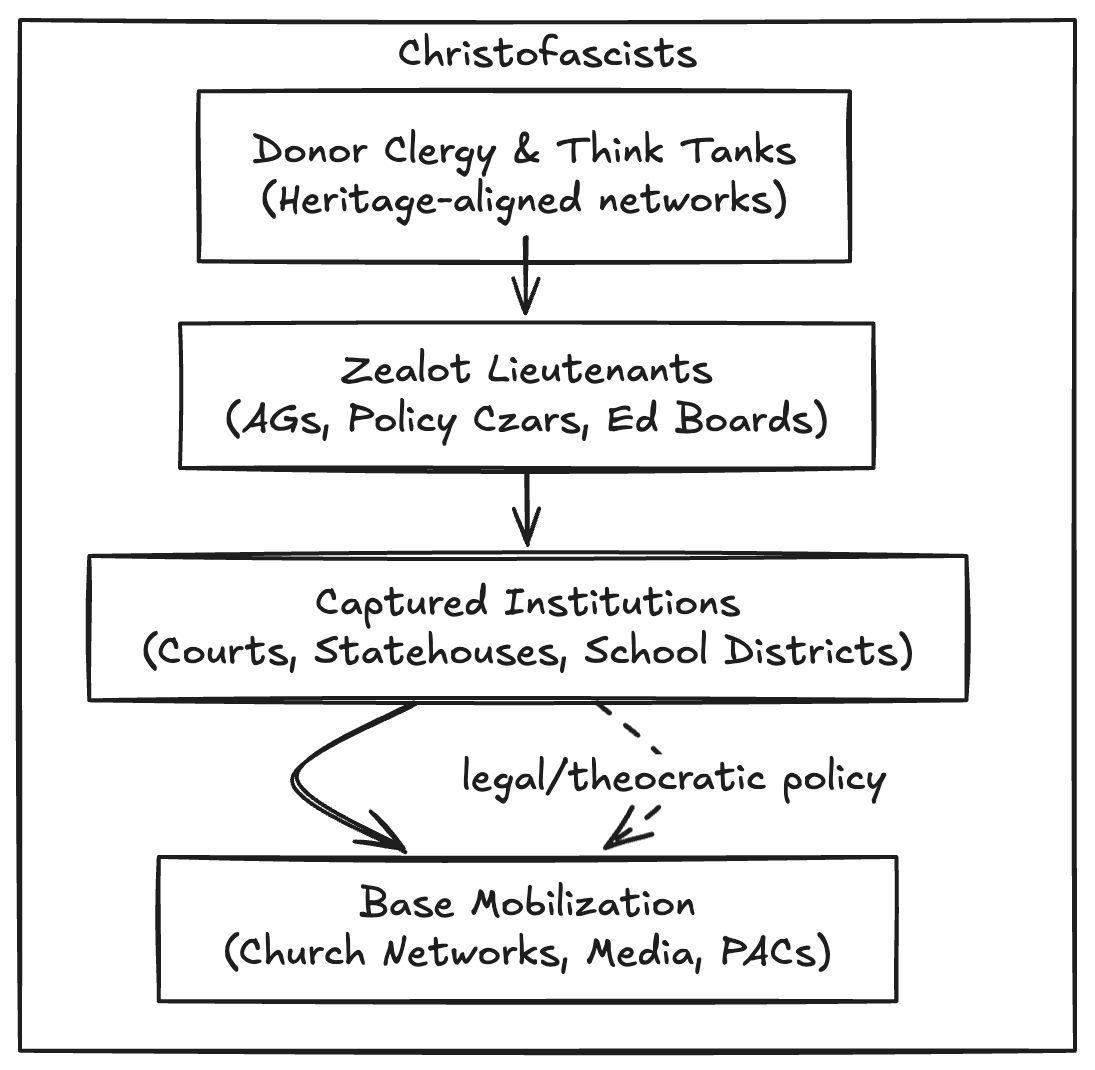
The second faction, in the meantime, believes salvation will come through scripture. Architected by the Heritage Foundation, their blueprint is Project 2025: a thousand-page document that openly outlines the plan for a Christian nationalist American state. Kevin Roberts, Heritage’s president, famously called it “the second American Revolution, which will remain bloodless if the left allows it to be.”
Like the technofascists, operatives from Heritage and their ilk are deeply embedded across the federal government, occupying key positions. House Speaker Mike Johnson calls the separation of church and state a “misnomer.” Russell Vought, Trump’s budget director turned inquisitor, diverts federal funds from social programs to “faith-based initiatives” and uses bureaucracy as a “moral” weapon.
Democracy is heresy to the Christofascists. It’s a rebellion against their divine hierarchy. The president is not a public servant but a chosen instrument of God, ruling by revelation rather than consent (though make no mistake, Christofascists and Technofascists alike hate Donald Trump, a godless and unprincipled egomaniac who is simply an easy-to-buy vessel for their ambitions). Their stated goal is theocracy, where law is derived from their interpretations of holy texts rather than the Constitution, where the Bible replaces the Bill of Rights, and where dissent is sin.
When they speak of “restoring order,” that really is just a demand that half the country kneel. They speak of repealing the 19th amendment and reducing women to homemakers and breeding stock. Queer Americans are to be erased by decree. Education is stripped of science and history in favor of “classical academies” that teach submission as virtue. Public life is re-engineered around prayer, punishment, and absolute obedience to those ordained by God to rule over the masses. It’s the Handmaid’s Tale, but with bluer skies, more paperwork, and Patriotic™.
This movement’s strength lies in its organization. The courts are fortified by the Federalist Society and the intellectual scaffolding is built by Heritage. They’ve spent half a century constructing a machine for theocratic rule, and they believe that this is their moment to strike.
Yet amid the seemingly impenetrable strengths outlined above, their greatest weakness is cultural gravity. Theocracy demands total control over hearts and minds, but culture has simply moved on. With broad public support for reproductive rights, same-sex marriage, and secular governance, ruling by scripture means ruling against the majority. And like all rigid hierarchies, it can only sustain itself through force.
The Kleptocratic Core
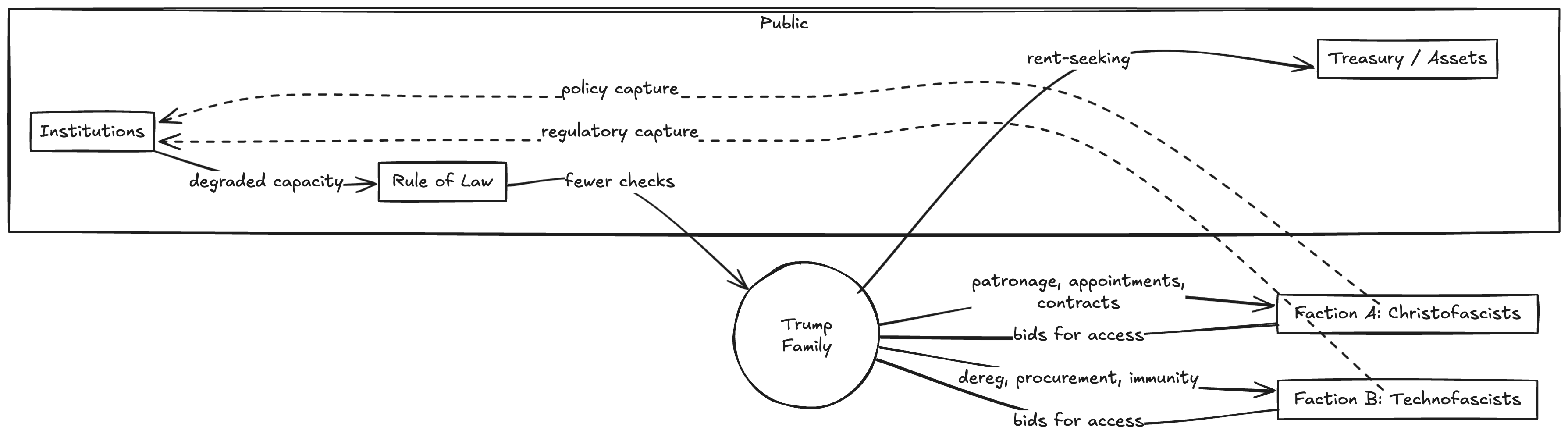
And presiding over both temples is Donald Trump: the false messiah of both creeds.
Trump is neither technocrat nor theocrat. He is, instead, a broker of chaos, a malignant narcissist who cares little about ideological visions of the fate of the Republic. What Trump is really selling isn’t ideology; it’s access. Every policy becomes a product; every appointment, a transaction. Crypto tycoons secure pardons through Trump-branded tokens. Sovereign wealth funds trade investments for policy favors. The Trump family converts government power into personal wealth, openly and shamelessly.
To the technocrats and theocrats alike, Trump is simply a useful tool — someone who will deregulate on command if the price is right, or an imperfect instrument of God serving a higher purpose. To Trump himself, though? He’s just a tollbooth operator on the highway to power. He’s indifferent to the ideological direction as long as the money, power, patronage, and public praise keep flowing.
The result is a regime that feels simultaneously futuristic and medieval: a digital oligarchy cloaked in religious pageantry, driven by a single overriding principle — graft. The state no longer governs; it simply grifts. And this transactional nature breeds a unique incoherence. What happens when Saudi and Qatari interests both buy influence? When tech companies crave immigrant labor, but Trump’s base demands closed borders? Simply (and dangerously): policy just goes to the highest bidder, and chaos reigns supreme.
Where Faiths Collide
For now, the hydra’s two heads are only able to coexist because they share the same enemies: secular democracy, free media, and the idea of equality itself. But their visions simply cannot occupy the same country forever, and cracks are beginning to show.
Tech oligarchs need foreign engineers; Christian nationalists want “walls.”Musk sells electric cars and futuristic dreams; Heritage preaches that climate change is God’s business, not man’s. The tech elite dreams of transhumanism; the religious right dreams of banning evolution. Silicon Valley wants unregulated platforms; the evangelicals demand censorship of blasphemy and porn.
Trump is facing a careful balancing act. He has to bless AI one day and prayer rallies the next. But it cannot possibly hold long-term, because when one faction gains ground, the other inevitably feels betrayed. The result is a sort of policy whiplash; a government that speaks two languages simultaneously — godless late-stage capitalism on one end and weaponized scripture on the other. And it’s unified only in its contempt for power in the hands of the many.
History itself offers grim precedents. Dual regimes tend to end with purges rather than partnerships. Stalin devoured his technocrats; Iran’s clerics subjugated their generals; China’s Xi Jinping dismantled the balance between party factions in favor of total control. It follows that the same logic will assert itself here. One empire will consume the other — or both will collapse under their contradictions.
Possible Futures
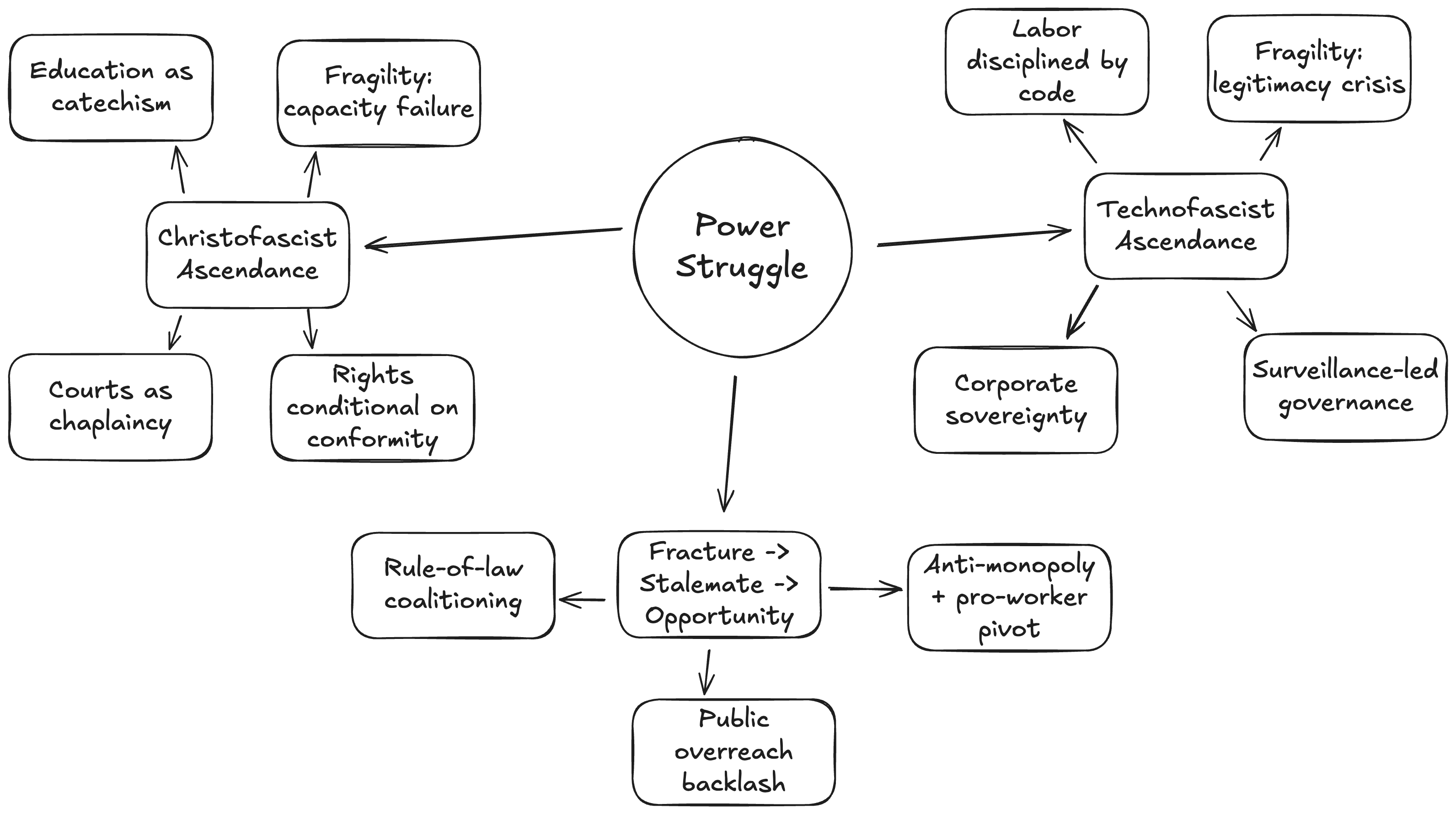
If the technofascists win, America becomes a sort of polished cage — a blue-skied dystopia. The surveillance machine will be absolute and the markets will boom. Any dissent will vanish behind interfaces optimized by enshittification and artificial intelligence. Religion will wither into private nostalgia. You’ll probably still get to vote, but your feed will tell you who to vote for, and your employer will know if you didn’t (Also, your feed and your employer will likely be owned by the same people).
On the other hand, if the Christofascists triumph, the nation will become the Y’all-Qaeda version of the classic conservative “sharia law” boogeyman, but as a superpower with nuclear weapons. The Constitution will survive in name, but rewritten to sanctify the “majority” faith of Supply Side Jesus. The economy will stagnate as dogma replaces research, women are subjugated, and queer people retreat into the safety of the shadows. The flag will fly over a new country that is the antithesis of everything the founding fathers envisioned.
Authoritarians hate sharing power — so if the factions destroy (or at least weaken) each other, the wreckage could offer democracy its last opening to eke out victory against tyranny. Authoritarian alliances tend to die of greed and incompetence before they die of principle. The machine wants infinite growth while the cross demands infinite purity. Between them lies an impossible equation. As the regime consumes itself through corruption, factional warfare, or the sheer incompetence that always follows tyranny — there may just be space for American patriots to mount a counteroffensive that rebuilds our broken system into something stronger than it ever has been.
But that window will not stay open for long. Every week the guardrails weaken; every month another institution bends. Tuesday’s elections offered a much-needed boost in morale to the growing coalitions that stand against American fascism. The question now is whether we can rediscover solidarity faster than the warring factions in the White House can finish the job.
Between the Algorithm and the Altar
The struggle defining this moment is not liberal vs. conservative. Traditional politics aren’t even really a factor anymore. It’s now a contest between two new American gods: the algorithm that promises order through data, and the altar that promises order through devotion. Both want to end the “chaos” afforded to the masses by freedom. Both offer a form of certainty in exchange for surrender of everything that makes us American.
But republics die not when they lose faith. They die when they give it to idols.
If America is to survive, it won’t be by choosing between the two heads of an authoritarian hydra — the machine or the cross. It will be by remembering that the concept of democracy was always meant to be a secular act of faith. Not in technology, not in theology, but in each other.
Good evening my friend, I’ve been seeing your posts quite a lot during my short time on Substack, I wanted to drop a comment to say how much I enjoy reading them.
While I’m here, I share a look some of the more obscure parts of history, through a philosophic lens.
Mainly focusing on historic books, as i collect them.
Here’s one you may enjoy on the Asian empire of Tartaria, a controversial subject:
https://open.substack.com/pub/jordannuttall/p/tartaria-in-the-17th-century?r=4f55i2&utm_medium=ios