

The Party of Reagan is Dead
Big government conservatives? Small government liberals? The rise and fall of GOP ideals in the "Age of Trump"

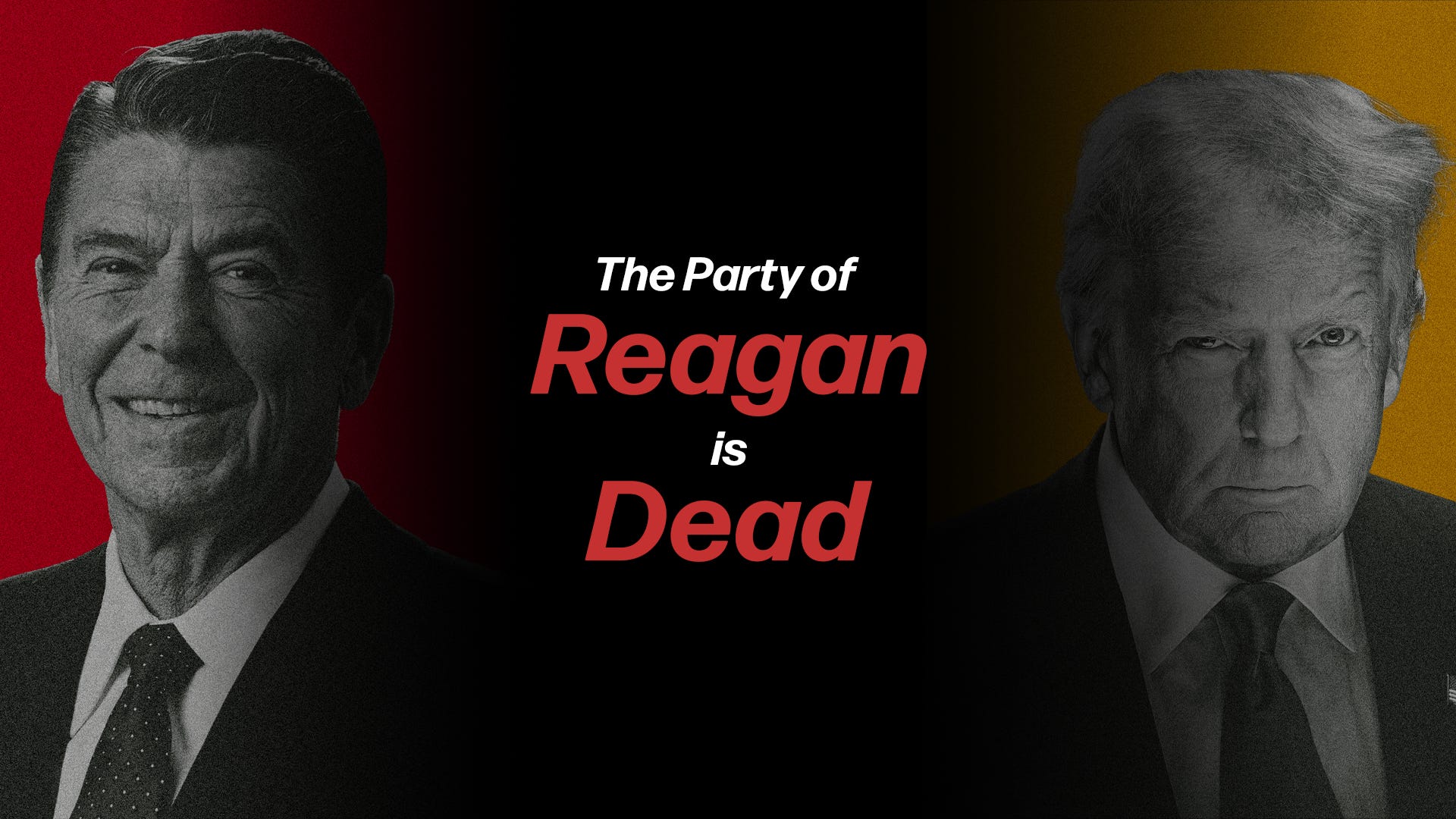
The Party of Reagan spent 40 years preaching the gospel of small government and states’ rights. And in a most stunning ideological reversal, they completely abandoned those principles in under a decade in favor of unprecedented federal expansion and authoritarian tendencies. Meanwhile, the Democratic Party — who brought the New Deal to life — is discovering a newfound appreciation for states’ rights, federalism, and limits on executive power. It’s a funny thing, and something worth exploring. If the republic survives Trump, it appears that the magnetic poles of our political system will have yet again reversed, and whatever comes next will be fascinating.
I grew up in the era when Republicans could recite the principles they held dear like they were scripture: small government, free markets, states’ rights, fiscal responsibility, and foreign policy that emphasized strength through deterrence. Their philosophy was that the federal needed to be constrained instead of celebrated; and that power belonged closest to the people themselves, in their own states and communities.
Whether or not you agree with those principles, they at least formed a coherent and fairly consistent world view: freedom flourishes when governments step back. Markets allocate resources better than any bureaucrat can. Communities know their needs so much better than Washington does. For decades, this was what the Republican Party claimed as its North Star.
Then came Trump, and with him, a complete ideological reversal. In less than a decade, the party that championed free trade now celebrates using tariffs as weapons. The party of fiscal restraint added trillions to the deficit and called it “beautiful.” The party that sounded the alarm bells about executive overreach over the Jade Helm training exercise under President Barack Obama now cheers as Donald Trump sends masked paramilitary forces onto American streets to snatch people and violates the Posse Comitatus Act by sending the U.S. military to perform law enforcement in our cities.
Meanwhile, Democrats are having their own “come-to-federalism” moment. Blue state governors are forming interstate compacts, asserting state sovereignty, and mounting legal challenges to federal overreach. Governor Gavin Newsom’s talk of “California values” is reminiscent of the same states’ rights fervor that once animated the Republican party. Whether by stockpiling abortion medications, creating state-level climate agreements, or building parallel institutions to protect their residents against federal intrusion, Democrats are beginning to understand why the concept of federalism was deemed so important in the first place.
The irony is delicious. The party of the New Deal and Great Society is now the one shouting “Tenth Amendment!” at Washington. They’re living what conservatives used to fear would come from an unrestrained executive: when the federal apparatus is controlled by authoritarians, federalism looks very appealing.
As it turns out, political principles are sometimes more situational than we’d like to admit. When you hold power, centralization is efficient. It gets things moving and it lets you deliver on your promises to the people, if you’re a politican who cares about that kind of thing. When you’re out of power, however, decentralization acts as protection. But this ideological reversal goes much deeper than mere opportunism.
For Republicans — and parasitic organizations like the Heritage Foundation whose long-term goals in America are actual dictatorship — Trump revealed that Americans who are hurting can be weaponized. He found power in appealing to peoples’ grievances and cultural anxieties. The constellations of think tanks and intellectuals who once provided ideological coherence for the Republican party have been largely purged. All that remains is populist nationalism wearing a Republican costume.
For Democrats, the shock of Trump has forced them into their own internal reckoning with their assumptions about federal power. They’re learning what claimed to know: a powerful federal government is only your friend when your friends run it. The administrative state can easily be turned against you. Executive powers you expand can — and will — be wielded by your opponents.
This ideological scramble has created a most fascinating incoherence in both parties. Republicans simultaneously rail against the supposed “deep state” while Trump and his handlers go full-steam ahead with unitary executive theory and attempt to assert federal control over private speech and states’ rights. Meanwhile Democrats defend institutional norms at the same time as they build state-level workarounds to limit federal authority. It’s been brewing for some time, but — especially after the 2024 election — it’s now become clear that neither party really has a consistent theory of governance anymore. With Donald Trump’s cannibalization of the Republican party, our duopoly can now seemingly only assume tactical positions based on who holds which levers of power.
This incoherence isn’t sustainable in a healthy democracy. Without real organizing principles beyond “whatever helps us win,” it becomes an inevitability for charlatans like Donald Trump to seize power. The constant flip-flopping in our politics erodes the public’s trust and makes it impossible to actually govern. How can you ever expect to build any lasting policy when the fundamental question of federal versus state power depends solely on who happened to win the last election?
So what comes next? It’s possible we’ll see a Republican party that openly embraces national conservatism and drops the “small government” pretense entirely in favor of using state power to enforce “traditional values.” Maybe Democrats will become genuine federalists who build a philosophy of progressive localism that achieves its liberal goals through state and local action.
Or perhaps our exhausted majority will demand something different entirely. A politics that isn’t about maximizing power when you have it and minimizing it when you don’t; a recognition that in a diverse democracy, different places need different solutions; a return to principled governance over partisan victory.
The Party of Reagan is dead — but so, too, is the Party of FDR. What rises from their ashes will determine whether our republic strenghtens or fractures beyond repair. The magnetic poles of our politics have reversed before and will almost certainly reverse again. The real question is whether we’ll actually learn anything from the flip, or if we’ll just keep playing the same old zero-sum power games until one entity amasses enough power to assert absolute control.
As always, feel free to reach out with any questions or if you just want to chat. You can find me on the following platforms:
Substack: https://unaligned.sh
Twitter: https://x.com/just_becs
Email: rebecca@unaligned.sh
This article comes at the perfect time, your insight into this ideological reversal is incredibly sharp. It's so vital to recognize these shifts and you articulate it beautifly, thanks for writing.