

King of the Hill: Culture War
The right now holds the cultural crown, but their aggressive agenda is focused on foes the median voter thinks are already beaten. The crown confers power — and paints a large target.

Treat the political culture war like King of the Hill: whoever’s on top sets the agenda and, more importantly, becomes everyone’s target. The right claimed the crown in 2024. In 2025 they’re learning that defense is a different game than insurgency — and that overreach turns the crown into a crosshair.
Everyone Aims Up
Picture a playground mound. One kid on top; rivals who were bickering a minute ago suddenly coordinate to yank them down. That’s backlash physics. Attention platforms are the hill; the “king'“ is the narrative center of gravity; and holding the hill invites coalitions of convenience from below. It’s not morality, it’s mechanics.
The hill is built from attention + institutions: recommendation systems and news cycles; courts and school boards; donor networks and brand-safety rules. The crown certainly brings perks (like framing power, first-mover advantage), but it also has costs (constant scrutiny, coalition fatigue). And so the loop repeats:
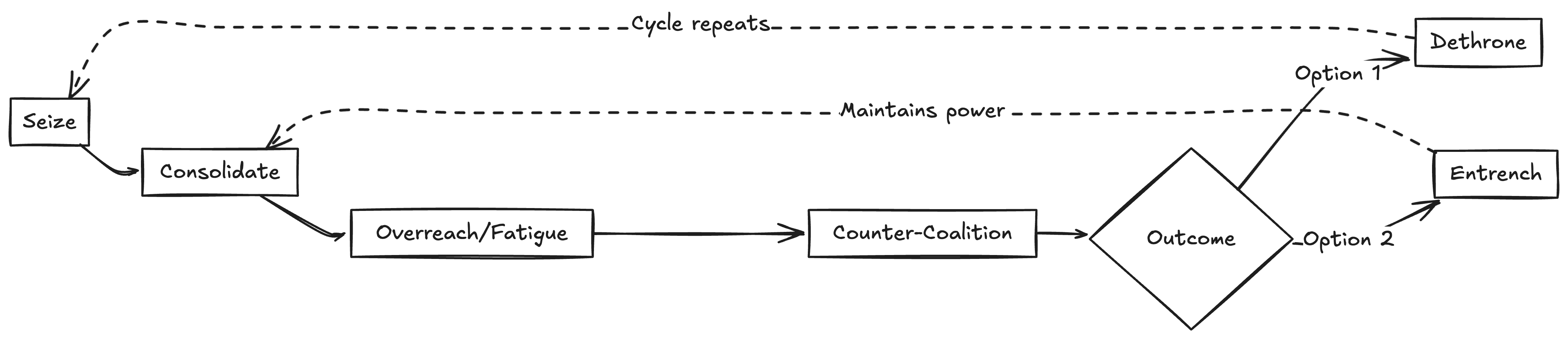
Social media research helps explain why the loop runs so hot: moral-emotional language travels faster than cooler speech, and engagement-ranked feeds tend to amplify highly charged, out-group-hostile content—even when users say they don’t prefer it.
2008 - 2016: Obama Era Ascendancy - Cultural Dominance and Overreach
With Barack Obama’s election and re-election, the broad liberal-left appeared to have, for all intents and purposes, won the culture war. We had a black president; same-sex marriage was legalized; broad acceptance of queer people rose. From pop culture to corporate America, institutions leaned into embracing and normalizing the diversity of actual American life. Anyone now in their early 20s might barely remember a different zeitgeist.
I’m going to editorialize here. As someone who supported the cultural advances of the Obama era and then felt alienated by the left’s internal culture civil war, Obama’s election — culturally, this piece is not getting into policy — felt like we were moving past racial division. Sure, you had the crazies who really couldn’t handle a black president. But broadly? It felt like society might finally close a painful chapter (yes, simplified; I’m describing a vibe). Ben Shapiro, whom I typically disagree with, has voiced a similar feeling during an interview with Ezra Klein. The legalization of same-sex marriage and rising acceptance of diverse gender expression felt like a final nail in the coffin of an unenlightened era that obsessed over how people look, love, and express themselves — rather than, in Martin Luther King’s formulation, the content of our character.
The war felt like it was over. The “conquering heroes” laid down their proverbial weapons. But, as so often happens among victors, a smaller group lusted for more fighting; high on the alluring euphoria of victory. Whether or not those causes were virtuous (often, yes), the strategy was flawed.
Self-Sabotaging Cultural Victory: The Leeroy Jenkins Approach
If you grew up online, you know the Leeroy Jenkins clip: the team is planning a hard raid, and one guy decides to just sprint in yelling “LEEROOOOOY JENKIIIINS,” causing the entire party to get wiped out. I’m being a bit cheeky, but the left’s strategy as cultural king had a similar problem. Most reasonable people wanted steady progress via careful strategy; a smaller group charged uphill into too many unwinnable fronts at once, with rhetoric that pushed even allies away.
If you spare some charity about motive, you can understand why they charged. You might even agree with their causes. But messaging matters.
“Systemic racism” describes real dynamics, but to many people the gut reaction is defensive: “Are you calling me racist?” The term isn’t about that, but words trigger frames. Same with “toxic masculinity”: not “all men,” but the culturally disengaged only heard attack.
Across front after front, the left’s messaging, rhetoric, and branding often didn’t help. Instead of “I’m right and if you’re not all the way with me you’re my enemy,” a softer, persuasion-first touch would have worked better. Counter disinformation. Focus on moving minds. Avoid maximalism as default.
Of course, this phenomenon isn’t unique to the left. The right, ascendant now, is making parallel mistakes — only faster.
2016 - 2020: The Trump Era - Fight for the Cultural Crown
Trump’s 2016 victory was an immense blow in the cultural battle. It wounded the left’s grip on the hill. Liberals who assumed their values were firmly in the mainstream shifted to defense; conservatives launched a full-scale counteroffensive led by Trump and MAGA. The cultural conflict escalated.
Trump styled himself as the culture-warrior-in-chief: constant Twitter shitposting, attacks on kneeling NFL players; a ban on transgender Americans serving in the military; nonstop railing against “political correctness.” The left mobilized in response: the 2017 Women’s March, #MeToo, pop culture and corporations leaning even harder into diversity.
Yet the louder the left roared, the more the right doubled down. The right found a bulwark in Donald Trump. Strange bedfellows emerged in that fight. Far-right fringes were emboldened and stepped into daylight: Charlottesville in 2017 and the murder of Heather Heyer; QAnon and InfoWars moving into the mainstream; sophisticated disinformation networks laundering illiberal narratives.
Then 2020 hit. COVID scrambled everything. Protests after the murder of of George Floyd brought the largest demonstrations in decades alongside riot footage that galvanized the right and alienated many in the center. Even now, years later and after the murder of conservative activist Charlie Kirk, we hear the right talk about how “we’re not burning down cities” in response to Kirk’s murder.
The 2020 election arrived and Donald Trump narrowly lost to Joe Biden. In the aftermath of the election, he lied about fraud and incited January 6th. The Senate declined to convict him for inciting the insurrection, clearly hoping to avoid another black eye on the party and losing the support of the MAGA base.
Victory was achieved. Culturally, however, it felt like a respite, not a clean win. The left struggled to regain cultural power. The Trump era battles left deep wounds in the cultural base, further splintering them into groups with maximalist focus on fringe issues rather than unifying. Too many mistook an electoral win for renewed cultural dominance.
Can you necessarily blame them? In hindsight, I suppose it did seem like we were finally able to put Donald Trump behind us as a country. That after 4 years of increasingly charged cultural battles, the right would also want to return to normalcy. To the left’s own chagrin, they underestimated just how deeply the culture war had become intertwined with electoral politics.
2024 Election: Final Shot in the Culture War
In November 2024, Donald Trump again won the U.S. presidential election. His tactics didn’t soften during his campaign; they intensified. He doubled and tripled down on the very things that Americans believed cost him the 2020 election. The left itself doubled down on fighting recklessly on difficult-to-win terrain in myriad cultural battles. Were they righteous fights to engage in? Sure. But they further weakened an already hobbled holder of the crown.
On November 6th, 2024, America woke up to a different cultural landscape. The reigning King of the Hill, the liberal left, was dead — replaced by the MAGA right. The war that had raged on for nearly a decade was finally over.
The battle may or may not have been won because of cultural issues — indeed, post-COVID elections were largely a rebuke of incumbents worldwide — but to say that cultural issues played no role would be naïve. Regardless, a politician who prioritizes cultural combat over governance was crowned. A new king stood on the hill.
Has the Right Learned From the Left’s Past Mistakes?
In short: not much. The right’s cultural agenda targets “enemies” that many in the broad public assumed were already defeated.
With control of the presidency, Congress, and the Supreme Court, conservatives have moved swiftly to consolidate their cultural victory through policy. But the aggressive approach risks a backlash that could prematurely cost them their newly-won dominance.
Since taking power in January 2025, the right’s approach to defending its cultural crown has been a scorched-earth offensive against the progressive advances of the past decade. Rather than pivoting to a unifying or forward-looking message focused on gradually returning to a cultural equilibrium that keeps the majority unperturbed, Donald Trump and the MAGA right have largely kept focus on punishing the left’s key constituencies and symbols. Nowhere is this more apparent than in the ongoing attacks on LGBTQ+ people — especially transgender Americans.
Over the past few years, anti-trans legislation has aggressively been pursued in Republican-led states, and it has only accelerated. By early 2025, 25 states had enacted blanked bans on gender-affirming healthcare for transgender youth. These laws have abruptly cut off medical care for tens of thousands of trans adolescents, despite evidence that such care significantly reduces suicidality and improves mental health for this vulnerable group.
And the aggressive fight has not only been on this front. From political pressure against companies practicing DEI to Florida attacking Disney with hostile legislation, the right has behaved like a conquering army, determined to crush any pockets of the left’s cultural influence. They’re attempting to send a message that no one, not even powerful companies, should cross the ascendant right’s cultural agenda.
The concept of “overextension” in warfare — when a force stretches itself too thin or pushes too far beyond what support can sustain — applies in the culture war context as well. Similarly to how the more radical messengers of the left weakened their hold on culture, so too it seems that broad public opinion is not on board with the extreme measures we see from the MAGA right in their new role as cultural victors.
In other words, the MAGA right — the current King of the Cultural Hill — seems to be speedrunning the last king’s mistakes (obviously through cruel and sinister means when compared to the left), seemingly with the hope that their gains can be codified in law. Whether this strategy will actually succeed in the end is anyone’s guess. But if you’re a glass-half-full kind of person, you could argue that cultural overreach is self-limiting: the hill punishes the heavy-handed.
Bottom line: the right holds the crown, but their aggressive agenda is focused on foes the median voter thinks are already beaten. The crown confers power — and paints a large target.
Please feel free to reach out if you have questions or just want to chat! Links to my other platforms are available below:
Substack: https://unaligned.sh
Twitter: https://x.com/just_becs
Email: rebecca@unaligned.sh