

Becoming.
On masks, choice, and the price of honesty.

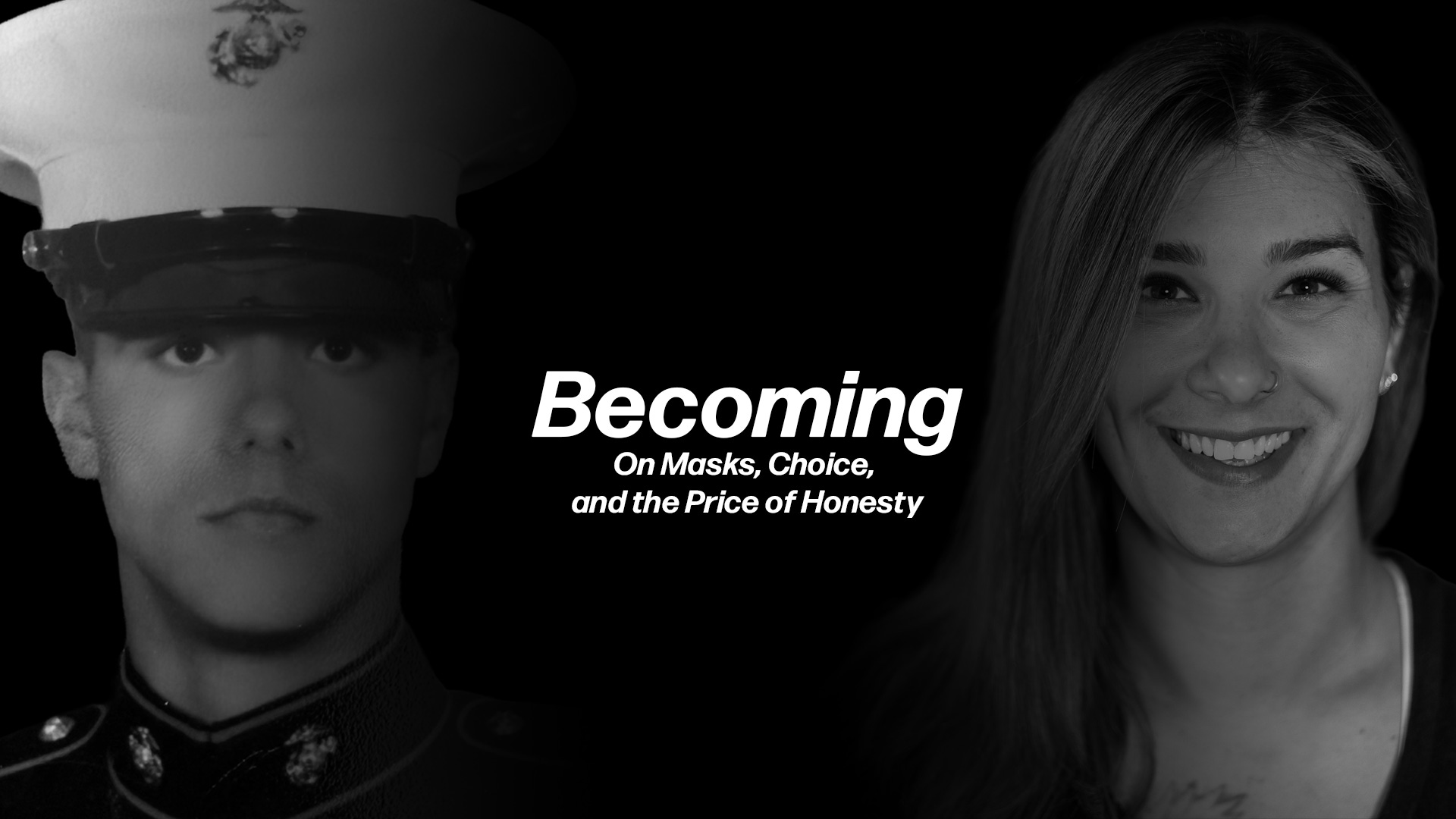
I believe attention, trust, and the privilege of having your words not only read, but taken to heart, are earned through unflinching honesty. Through vulnerability. Through candor. This piece is my audition for your time: my humanity on the table to show you I’m just as scared of this political moment as you are, and that I’m here to fight, somehow, for a better country and world. For our children, for our families, and for goodness everywhere.
Content Warning: Suicidal ideation
As a child, my father used to tell me, “You owe your mom and me nothing but to give your child a better life a better life than we gave you.” We were first-generation immigrants. They fled Romania after the 1989 revolution that ended with the execution of Nicolae Ceaușescu and his wife. We were poor. To make ends meet, my father worked in a factory by day and drove a cab at night. My mother stayed home and raised me until I was old enough to go to school, then she went to work too. Through the foggy haze that remains of my childhood memories, that platitude stuck with me. One day I’ll tell my son the same thing. Our children don’t ask to be born. We owe them everything; they owe us nothing. And that’s how it should be.
I remembered my father’s wish the day I received my Eagle, Globe, and Anchor. After finishing the Crucible I stood exhausted in formation. My drill instructor placed the emblem in my hand and called me what I’d been waiting to hear: Marine. It felt like a weight settling onto my shoulders in the shape of relief. As a teenager I’d been rudderless — flirting with gangs, drugs, and risk, as if danger might answer a question I was too afraid to ask. The uniform gave me an answer: I could serve something bigger than myself, and the chaos would quieten. And for a while, it did.
Wearing the did quiet the chaos for a time, but not the question underneath it. I built a life and learned to fight through the static. After many years, as the static resolved into a single, undeniable frequency, I had to face that question directly. It was like being chased down a long hallway with no doors, knowing that you’ll eventually reach the wall and have to turn toward your tormentor.
I write because the country that raised me — an immigrant kid who really believed in the American idea — has become something smaller and crueler than it was meant to be. We’ve built a politics where outrage is profitable, cruelty is a meme, and humanity is only as valuable as the current news cycle allows. Launching Unaligned is my refusal to play that game. I’m making a bet that sanity can scale, that abundance can be a coalition, and that the most radical act we can take right now is to remember each other’s humanity.
This piece explains how I got here. In all honesty, I’d rather not make myself visible while the federal government is actively hostile to people like me. I’d rather write fiction, lean into photography, and launch new startups. But when speaking out invites turbulence and authenticity is increasingly scarce, silence feels like neglect. My voice, as small as it may be, is all I have.
If you’ve been looking for a place that takes truth seriously, invites good-faith debate, and holds the idea of what America could be in the absolute highest regard, follow along with Unaligned.
Mask, Choice, and Cost
For years I performed a version of myself that could blend in with the world. I’d wake up, feel my pain for a brief moment, then put on my armor — jokes, habits, a voice tuned to the room — and hope the day wouldn’t ask me any questions that I couldn’t answer. The pain wouldn’t shout; it hummed, steadily. It lived in the pauses between conversations, in the quiet of a long drive, and in the way I would throw myself at risk because danger was the only way I could feel alive. I told myself I was fine. I told myself a lot of things.
The night the lie ran out wasn’t dramatic from the outside. A house asleep. Doors closed. The kind of silence that makes you hear your own heartbeat. In the depths of near functional alcoholism and excessive marijuana use to numb an ever-present pain, I finally uttered a sentence that, as a means of self-preservation, my psyche had desperately fought to subdue since I was four years old. It was the reluctant acceptance that, for one reason or another, I was born with a body and a soul that just didn’t match. It was a shattering of reticence that, for decades, sought to keep me safe from the cruel world around us. Denial swarmed my mind — it can’t be true; I’m not the caricature on TV; what about my family? The ceiling didn’t part; the room didn’t change. But something in me finally unclenched — like a fist, finally released. The choice in front of me became painfully clear: live honestly or stop living at all. From puberty until that night in my early 30s, I had thought fondly of death almost daily — craving its release, but too afraid to hurt the people I love. But when the choice finally presented itself, I chose life. I chose to stop fighting against a current that I could never hope to overpower. I chose to stay for my wife and for the son we were bringing into the world. I cried tears that I had held back for decades.
Telling my wife was the next act of courage. There’s no script for that conversation, no guaranteed outcome, only the hope that love is big enough to hold a truth that neither of you ever planned for. She listened to me. She loved me. “We’ll take it one day at a time together,” she said. That grace — which meant more to me than I could ever possibly express, let alone repay — became a bridge I could walk across without looking down. The months that followed were small, human-scale acts: trying on a name until it fit, telling a few people we trusted, and letting the mirror finally be a place to meet myself instead of dodge myself. We were preparing to welcome our son into the world, and the calculus of my life became so clear. He deserved a parent who was present and honest, not a ghost wearing a mask.
The weather inside me began to shift. The background sadness that had colored everything since adolescence finally began to lift. I was softer with the people I love; steadier in the mornings; less at war with myself. The old parts of me — curiosity, happiness, love, the instinct to meet people where they are — began to come back online. I reveled in that newfound joy of actually experiencing life for a change. And after a while, my work started to take shape. If I had been given a chance to live, what would I use it for? I wanted a sort of responsibility. Speak when you can. Humanize where you must. Help build the world your kids will inherit.
To be clear, none of this was free. The first bill came due in a friendship I had always thought was durable — a friend I had hoped would be a buoy for me in these rough waters. But one day that text thread just…thinned. Fewer check-ins, slower replies, less engagement. No blowup or principled disagreement to dissect — just distance that wouldn’t actually say its name. I tried to explain what was happening inside me, and the replies just got shorter. It’s amazing how loud a quiet phone can be. Losing that friendship hurt more than open hostility would have. Anger at least gives you something to push against. Silence only gives you yourself.
Social transition, too, is hard in ways most people don’t see. You can be outgoing and happy-go-lucky, but still feel your shoulders go tight in every room. How am I supposed to act now? Do these people actually accept me or are they just tolerating me? And so the second bill was social gravity. People I’ve known for years — people I’ve counted among my closest friends — didn’t ask questions. Not even simple ones. No “How are you really?” No “What do you need?” No “Can you tell me about your experience? I want to get to know the real you.” I don’t think most of it was cruelty; I like to assume good faith in everyone. Perhaps it was simply discomfort in search of an exit. But the effect is the same: alienation.
Meanwhile, the top of the government has continually found new ways to say people like me are a problem to be “dealt with.” Ordinary people are tired of politics — and who can blame them? — but there’s a certain privilege in being able to treat politics as optional. When you’re unaffected, disengaging makes sense. When you’re a target, the smallest acknowledgments matter. When someone in your life asks sincere questions and wants to hear your answer? It means the world.
Even safety became a choreography. When we go out as a family, I clock rooms instinctively — where the exits are, whose gaze lasts a second too long, whether it’s safe to use the restroom, where to sit so my son doesn’t have to learn adult fear before he needs to. That mental calculus runs constantly in the background: be visible enough to be human, blend enough to be ignored. I’ve debated concealed carry more times than I can count — not because I want to play hero, but because I refuse to be a passive character in my own life if someone decides I’m a symbol. I hate that calculation. But I also can’t pretend it isn’t real.
And yet, the inside of my life got better. The fog that settled over everything since adolescence finally lifted. I’m more present with my wife; I’m gentler with my parents; I’m a steadier parent to my son. Joy returned in ordinary ways — making breakfast, reading at bedtime, catching myself laughing and feeling real joy. Becoming myself didn’t erase my loss; it put it in scale. Some days I still grieve what fell away. But most days, I’m just grateful for what stayed and what became possible.
If there’s a name for the price I’ve paid, it’s tuition. This is what it cost to learn how to live honestly and to understand what courage looks like when other people depend on you. It taught me what I can’t outsource anymore: my safety, my voice, and my responsibility to humanize a group that has been reduced to propagandized headlines. The costs clarified the stakes. They’re why I’m building something instead of just enduring.
Why I’m Writing This
I typically write about the political zeitgeist — electoral strategy, video essays, conversations and debates. This piece is different: it’s part memoir, part coming-out, part attempt at properly introducing myself to my readers — and yes, a (hopefully immersive) window into one person’s transgender experience. More importantly, it’s me reaching out across the digital void to try and establish trust in a voice I promise will stay authentic.
In a period of time where information is weaponized and digital authenticity is dying, sincere truths are a public service. When speaking out invites turbulence you could avoid by simply staying quiet, words become courage. Under national leadership so morally weak it thinks the greatest power lies in the sword, the pen must stand as a bulwark — to help prevent bloodshed, and to remind the brutes that those who first seek the pen are often more effective than the tyrants who worship the sword.
As always, feel free to reach out with any questions or if you just want to chat. You can find me on the following platforms:
Substack: https://unaligned.sh
Twitter: https://x.com/just_becs
Email: rebecca@unaligned.sh
Author’s Note:
This essay is more personal than my usual work. If you’re here for strategy and analysis, that continues. I’m sharing this now because trust is the soil that better politics grows in; I want you to know the human who’s asking for yours.
Great writing! Just want you to know that I know how healing writing can be and I’m with you. ❤️ Doreen
❤️❤️