

A Fork in the Road: The Unaligned Thesis
The guardrails are gone. We can duct-tape the wreckage or build something sturdy: a middle-out media push to counter an authoritarian machine. No purity tests. No cults. Just a country worth living in

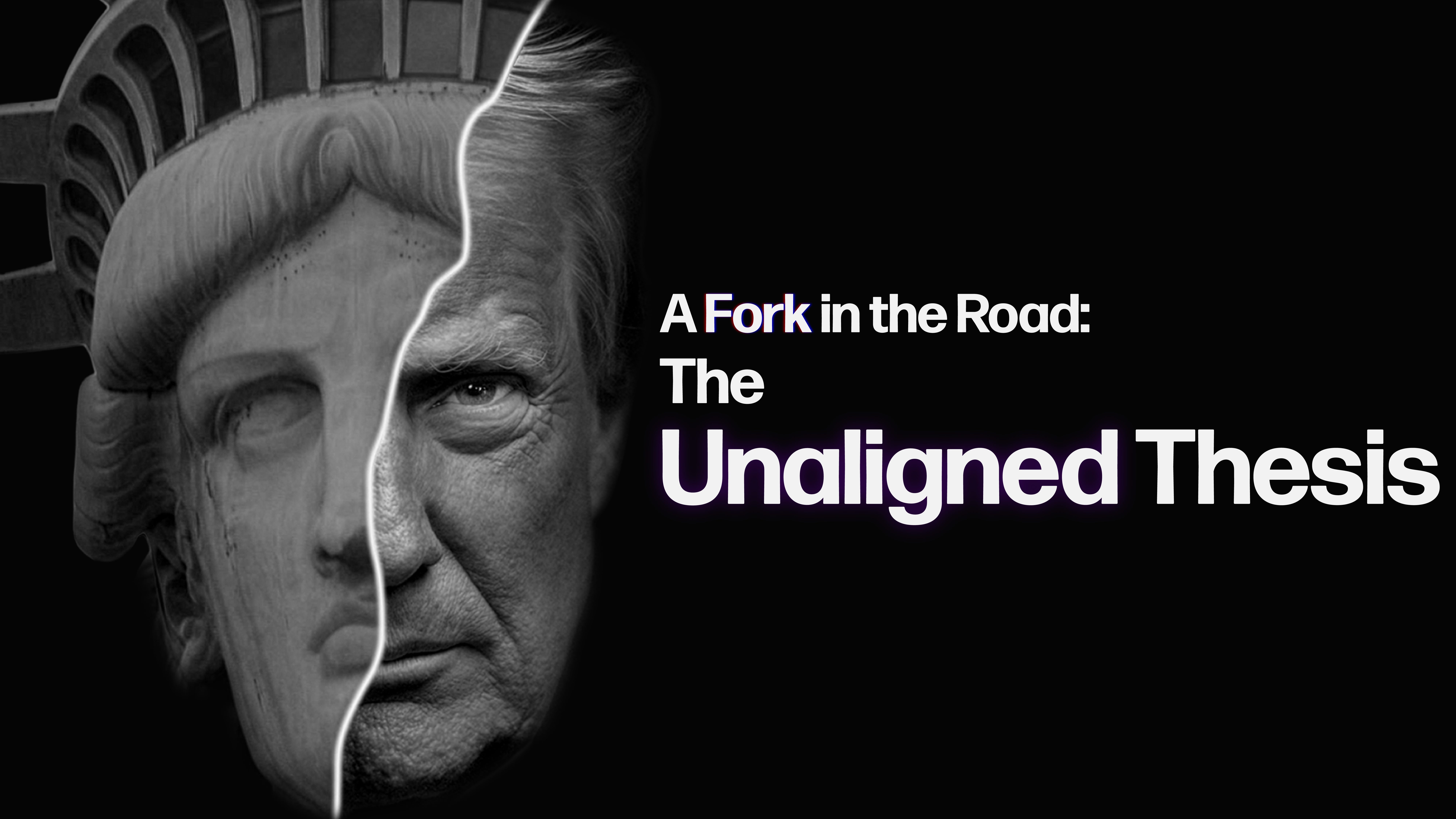
America is approaching a stark choice — and it isn’t left versus right. It’s violence or reform. We can keep sliding toward a bloody national divorce, where extremists dictate the terms of politics and rip the country apart. Or we can disrupt the establishment itself, forging a coalition that exists within both major parties but answers to something larger than either. Donald Trump exposed just how fragile our system really is — how a president can bend norms, sidestep laws, and smash through guardrails. He used that power to break democracy.
What if those same lessons could be used to save it? This is a two-front fight: first, a middle-out media offensive to deprogram and de-escalate; then an institutional alliance to usher in a saner political order.
The Choice: Violence or Reform
I’ll be blunt and a little hyperbolic. The American Republic is rapidly accelerating toward a fork in the road. Violence, bloodshed, and effective collapse of our system await us on one side. The details are hazy, but the big picture is bleak. The other side is hidden in a dense fog. It’s uncharted territory, and all we have are semi-educated, hopeful guesses about what might await us beyond that pale.
Take off your partisan hat for a moment. If you’re a Democrat, forget for now the many sins of Donald Trump: the weaponization of government, the destruction of norms, the rules and laws that once kept our political order stable. If you’re a Republican, temporarily set aside the rudderless, soft-on-crime, milquetoast catering to the “ultra-woke” causes you see in the post-Obama Democratic Party.
Now ask yourself: what do you see in your everyday life? You interact constantly with people who voted both for and against Donald Trump. Most of those interactions are cordial, often even pleasant. You’re not running into the seemingly psychopathic personalities we imagine represent the “average” on the other side. Why?
The answer is simple: because most of us are not radicals. Yet we are represented to each other by the most radical voices on our own side. If you’re a Republican, understand this: the social media feeds of most left-of-center people portray the average Republican as a brain-dead MAGA cultist who dreams of theocratic dictatorship. If you’re a Democrat, ask your right-of-center friends: they’ll tell you the average Democrat is a literal communist who wants open borders, undocumented immigrants voting, and gun confiscation along with rampant crime. And of course, also authoritarianism.
This is the reality of the attention economy. Social media algorithms don’t reward nuance; they reward outrage. And as much as we may want to believe otherwise, that isn’t an ideological choice. Like most things in our dumbest timeline, the reality is worse: it’s just profitable. Companies like Meta pay psychologists millions of dollars per year to optimize how long they can keep you scrolling. And what’s the discovery? Outrage sells. Anger makes you engage. Engagement shows you more ads. I wish I could say there was some sinister conspiracy here, but there isn’t. It’s unfortunately much simpler: publicly traded companies need infinite growth, quarter after quarter, year after year, and whether that growth comes at the cost of democracy is irrelevant.
The blame doesn’t rest solely on tech CEOs. They’re just following the incentives of our current iteration of capitalism. The real danger is the political grifters who exploit this attention economy to pit us against one another. They are sociopaths who don’t care about tearing the country apart while raking in hundreds of thousands — sometimes millions — every month. They profit by making you, a Republican, hate me, a Democrat and a transgender American. And the most infuriating part? They’re rarely motivated by principle or ideology. Almost always, it’s just the almighty dollar.
And the greatest trick of these grifters, these provocateurs, these sociopaths who have no care for our constitutional republic? It’s convincing you and your neighbors that the culture wars dividing us — guns, DEI, religion, ~10 transgender women in collegiate sports — are somehow bigger than the things that unite us: rent is too high, housing is unaffordable, wages are stagnant, health insurance companies bleed us dry while denying claims, young men’s mental health is largely left behind and young women are increasingly subjected to impossible-to-achieve standards. I could list dozens more.
As someone viciously attacked day after day by the current administration, I know how hard it is to lay down my proverbial weapons against the MAGA crowd. When I watch the President of the United States of America repeat the words “men in women’s sports, transgender for everyone” in every single public speech like it’s a slogan; when conservative media desperately tries to find any possible link to a transgender person regarding the Charlie Kirk shooter; when a sitting Congresswoman openly and repeatedly refers to transgender human beings as “trannies”; when the Department of Justice reportedly considers banning transgender Americans from firearm ownership — I want to hate everyone who enables it. The visceral part of me wants war. But I know in my heart that the average American wants something simpler: a life of abundance, free from the constant churn of the culture war. And I know they’ve been lied to, manipulated by grifters and opportunists who crave power more than they care about their fellow human.
Hear me: we, as Americans, need to come together — more now than at any other time in our history. The Republic is under attack. Your algorithmically curated media feed may not show it, but the danger is real. In the age of technology, the attention economy, artificial intelligence, and democratic backsliding, we face a choice: keep marching toward violence, despair, and destruction, or take the foggy, uncertain path of reform that at least offers a chance to save the Republic.
Choosing reform means stepping off the collapsing highway and into the fog. The road we’ve been driving on is destroyed — its guardrails smashed, its pavement cracked, its traffic signs treated like decorations by leaders who wanted power more than a republic. Trump didn’t just break the rules; he proved how flimsy they really were. And the establishment’s answer? Pretend the wreckage can be repainted and called “normal” again.
That’s a lie. We can’t duct-tape democracy back together. The guardrails won’t reattach themselves. If we want a system that survives the next storm, we can’t be afraid to tear down and rebuild. That means breaking rules not to destroy them, but to create new rules that actually protect us this time. It means refusing nostalgia, rejecting passivity, and doing the uncomfortable thing our politics has avoided for decades: rewriting the operating system before it crashes completely.
The choice is clear. The coward’s path is clinging to what’s broken. The harder, braver path is breaking what must be broken — so that freedom, fairness, and the republic itself can be saved.
Phase One: The Middle-Out Media Offensive
Like it or not, the battlefield is media — not cable news, but the algorithmic feed where most people now live. If we want to pull the country back from the brink, we have to fight and win there. That means wresting narrative control from the organized mis- and disinformation networks aligned with the current administration and its media allies.
You’ve seen the pattern. A damaging story lands. For a day or two there’s visible dissent on the right. Then, almost in unison, the conversation snaps into place: identical phrases, mirrored talking points, synchronized clips. The narrative runs down a pipeline — first-tier commentators and journalists seed the story; partisan podcasters and streamers amplify it; meme accounts distill it into bite-size slants for every attention band. The result isn’t only insulation for authoritarian behavior. It’s an engine that polarizes ordinary people and normalizes contempt for democratic constraints. That’s the sophisticated machine we’re up against.
Our counter-strategy must be a public alliance of center-left and center-right creators — journalists, podcasters, debaters, streamers, thinkers, and influencers — running a coordinated middle-out campaign. We start with the lightly political and the apolitical on the right: people whose view of Trump and governance is whatever leaks through the outrage machine. The goal isn’t to turn them into liberals. It’s to give them an off-ramp: a credible, face-to-face invitation to reject authoritarianism and demand normal, competent, rights-respecting government. In parallel, we confront the propagandists directly — debate them, challenge claims in their own spaces, and, when they inevitably begin to retreat from open debate, take the case to their audiences on platforms built for casual political conversation, like TikTok. Step by step, we deprogram from the middle out.
This isn’t about purity tests or viral clips. It’s about de-escalation and reintroduction to reality: correcting core falsehoods, modeling good-faith disagreement, and centering shared material wins — cheaper life, safer communities, more opportunity. It’s also about cadence and craft: coordinated content, recurring joint streams, rotating guest chairs across the aisle, mirrored talking points where they make sense, and visible moments of “we disagree on X, unite on Y.”
I’m not a professional organizer, and I’m certainly not wealthy enough to fund a network. But I want to do my part in the fight for deprogramming Americans who have been lied to by these sophisticated disinformation networks — and I’m asking creators and communities on both sides of center to do theirs. If we can move the middle, we can change the incentives. If we change the incentives, the temperature drops. That’s Phase One.
Once there’s daylight between the public and the outrage machine, we need institutions that won’t snap back to dysfunction. That’s where an inside-the-parties governing bloc comes in.
Phase Two: The American Alliance (Institutional)
The “American Alliance” (not an official name by any means) is a cross-party coalition that behaves as a third party, but operates inside both parties. It’s Phase Two — the institutional follow-through once the middle-out media work has opened space for sanity. Candidates keep the “D” or “R,” but publicly pledge shared principles and agree to govern together as a bloc. No spoilers. No third-party trap. Just a (peaceful) hostile takeover of politics-as-usual. In Silicon Valley, startups “disrupt” aging industries that are slow, ineffective, and allergic to change. That mindset can be applied to American politics.
The Tea Party movement hypothesized that political takeover within a party was possible. Donald Trump proved that it could be done — the “Party of Reagan” is effectively dead, and MAGA killed it. So what if a new coalition could use similar tactics to upend the two-party system — not only beating back the authoritarians corroding our government, but replacing the very political establishments that enabled the takeover in the first place? What if this coalition could bring about a new political order that elevates agile, builder-minded leaders who actually treat democracy, liberty, and justice as non-negotiable?
Why now? Because the exhausted majority is politically homeless. We align ourselves with the left or the right, but on average, Americans feel their political leaders are failing to actually deliver on meaningful policies that make their lives better. They want competence instead of chaos, freedom without intrusion, and problem-solvers instead of culture war performers chasing viral clips because they’re too weak or corrupt to actually govern. This alliance is their home.
How it works: organize in both primaries, recruit pragmatic candidates, and bind them to a simple covenant — protect rights, lower costs, build abundance, tell the truth, and vote together on the big stuff. Use the parties’ own machinery to force negotiation, moderation, and results.
What does our alliance look like?
On the right: Republicans who see Trumpism as anti-American at its core; voters who don’t care about the culture war du jour and want a government that does what it does best and leaves the rest to the market.
On the left: Democrats ready to shed the far-left’s baggage — a loud but deeply unreliable voting bloc that drags the party into cultural firefights on unwinnable ground instead of focusing on steady progress; voters who believe capitalism can work if we try to fix what’s broken, rather than chasing utopian ideas that human nature itself just won’t allow for.
Sane, reasonable individuals who are willing to actually meet at the negotiating table and work together toward building a society of abundance again and restoring the American dream. They recognize the eerie echoes of 1930s Germany and desperately want an off-ramp — and they’re willing to, in good faith, set aside the deep political division and hatred that has been building in our society, in order to save it.
Most importantly, the alliance looks like voters and leaders who want to improve everyday life. We will disagree on implementation. We will debate and disagree. But instead of blind party-line votes driven by fear of the president or primary threats from special interests, we’ll hammer out real consensus on issues that actually affect people. Humanity and democracy are not on the table — we’ve seen what happens when those become negotiable. It’s what brought us here in the first place.
This is a pivotal moment. The old norms are shattered. Democratic institutions need to be disrupted by a new political order that is agile, attuned to modern realities, and responsive to Americans’ needs.
The American Alliance is how we do it.
Breaking the Rules to Save Them
Every system has breaking points. America’s laws, norms, and institutions were never sacred — they were scaffolding, built by people, for people. And like all scaffolding, they can rot, buckle, or collapse under pressure. Trump showed us just how brittle they really were. He bulldozed guardrails, bent rules until they snapped, and proved that power in the wrong hands can make the Constitution look like little more than paper on a podium.
So here’s the hard truth: we can’t save democracy by worshiping the very rules that failed to defend it. We have to do the opposite. We must be willing to defy the old playbook — challenge institutions that calcify instead of protect, rewrite rules that reward corruption, and break traditions that were never designed for all of us in the first place.
To be clear, this isn’t destruction for its own sake. On the contrary — it’s renovation. Any republic worth living in demands bold remodeling, not timid repairs. That means ripping out the rotten beams, replacing warped foundations, and refusing to treat the political order as untouchable. If we keep mistaking reverence for strength, the house will collapse on top of us.
The establishment will call this reckless. They will say it’s dangerous to touch the old structure. And honestly? I can’t say I disagree. But the danger is already here. The foundation is being hit with a sledgehammer while we hope and pray that it won’t buckle. The choice at our feet now isn’t between safety and risk. It’s between letting rot consume us, letting the sledgehammer bring us down, or daring to rebuild before it’s too late.
Is it already too late? I honestly don’t know — but I still think we need to fight like hell to try and save the spirit of what America was meant to be. What it still could be.
We can use the very lessons Trump and his cronies have taught us about the brittleness of our rules as weapons against the very forces that seek to destroy the republic for their own personal gain. That requires something bigger than one party. It requires an inter-party coalition. A third party without the wasted-vote trap. A political force that cannibalizes the establishment itself and reshapes it toward nobler ends: liberty, justice, and the forced disarmament of authoritarian movements before they ever have a chance to consolidate power.
Is a coalition like this possible? I think it is. I believe, in some sense, that it already exists, and it’s hiding in plain sight — its members unable to see one another due to the polarizing veil of the social media algorithm; blind to each other’s similarities because of the intricate and sinister pipelines of political influence that aim to keep them apart.
If you believe in the principles of liberty and justice for all; if you yearn for a society where we build abundance rather than managing scarcity; if you love the promise of what America is supposed to be, then I think you might consider yourself a part of this group.
The Call: Pick the Road That Leads Forward
We don’t have forever. Either we unite across parties against fascism now, or we risk losing the Republic itself. The choice isn’t left versus right anymore; it’s repair or ruin.
I’m not a professional organizer, nor am I a political leader. I’m one person with a keyboard and a deep love for my country. That means that people with real experience — campaign pros, policy hands, community leaders, fundraisers, alternative media creators, volunteers — are needed in every lane of this coalition if it is to ever have a chance at success.
Why am I doing this? It’s certainly not for money. I work in technology and am admittedly comfortable enough to not have to carry many of the day-to-day financial burdens that most Americans do. But I grew up poor. I’ve been working class. I’ve felt the pain that both conservatives and progressives talk about. If I wanted to get rich off of politics, I’d try to join the margins and stoke outrage for clicks — cash in while the system collapses. I’m not doing that. I’m doing this because I love this country and the people in it. I believe in the ideal of America — the promise of the American Dream. I’m no longer in the military (and, thanks to Donald Trump, I can’t legally serve again), but I’ll be damned if I let the Republic die without at least trying to do my part — as small as it may be — to help right the ship in some way.
This might fail. Maybe the whole idea falls flat and I just end up as another liberal commentator shouting at the void. But at least I, and we, will have tried something. That’s more than we can say for the cynical opportunists who just want to further divide and break us.
This project isn’t about me. It’s about us. If any of this hits home, join the Unaligned community and help build a better country.
If you create content — even part-time — on the center-left or center-right, and you’re willing to collaborate across that line, reach out. If you’re not a creator, you can still help: share cross-partisan collaborations, invite a friend from the “other side” into a stream, to listen to a podcast, to read an article; and starve the outrage machine of your clicks.
Substack: https://unalignedpolitics.substack.com
Blog: https://unaligned.sh
Twitter: https://x.com/just_becs
Email: rebecca@unaligned.sh
❤️❤️